
As organizations move beyond experimenting with artificial intelligence and into deploying systems that directly affect customers, employees, and business outcomes, one reality is becoming clear: governance frameworks alone are not enough. The next challenge is technical execution—knowing how to actually test, evaluate, and stress AI systems before they fail in the real world.
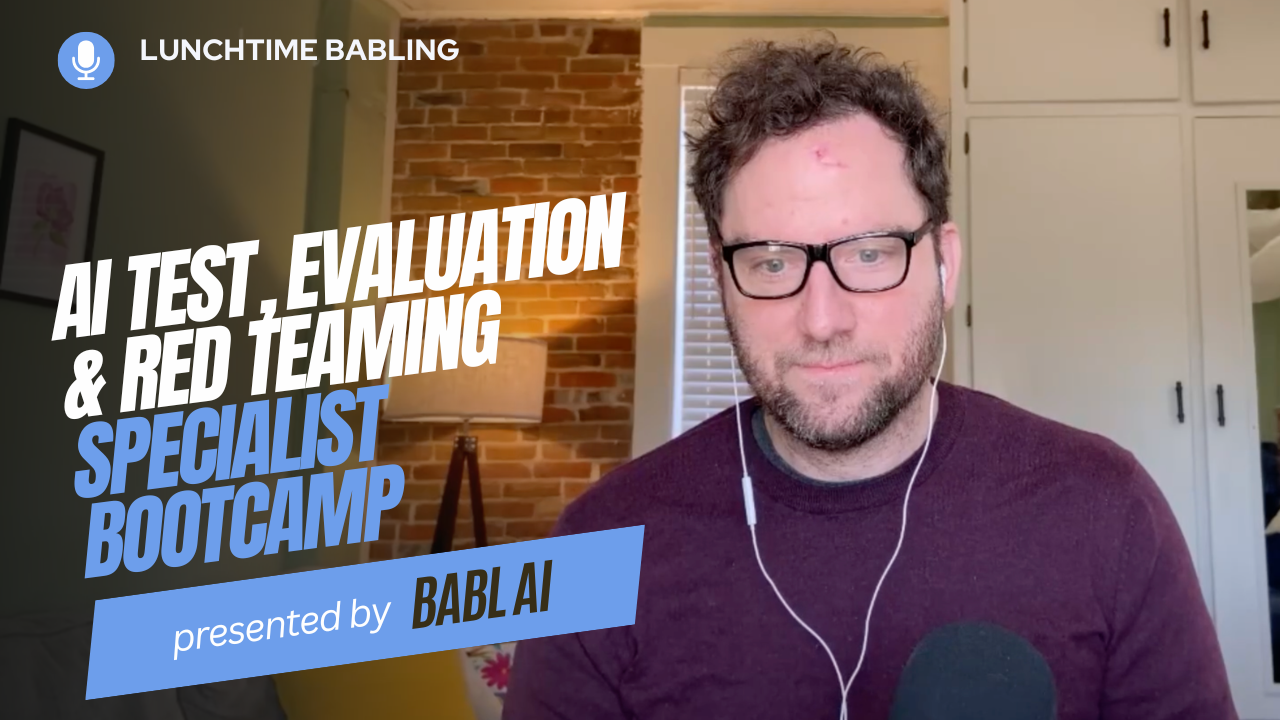
In the latest episode of Lunchtime BABLing, BABL AI CEO Dr. Shea Brown introduces a new initiative designed to close that gap: the AI Test, Evaluation, & Red Teaming Specialist Bootcamp. The episode explores why BABL AI created the program, what makes it different from traditional governance training, and why hands-on technical evaluation is rapidly becoming one of the most important skills in the AI assurance ecosystem.
From Governance to Technical Assurance
AI governance has matured quickly over the past two years. Organizations have built policies, risk frameworks, and compliance structures to prepare for regulations like the EU AI Act and emerging global requirements. But according to Shea, many teams are discovering that policies alone don’t answer the most practical question: does the system actually work safely and reliably under real conditions?
Testing and evaluation are where theory meets reality. Governance tells organizations what they should manage; testing reveals what actually happens when AI systems encounter unexpected inputs, edge cases, or adversarial scenarios. The bootcamp is designed to bridge that gap by training professionals to move beyond documentation reviews and into direct system evaluation.
Why a Bootcamp—and Why Now?
Shea explains that the program grew directly out of BABL AI’s internal audit and assurance work. As the company evaluated high-risk AI systems across industries, a consistent pattern emerged. Many professionals understood governance concepts but lacked practical training in how to design test plans, execute evaluations, and interpret results in a meaningful way.
That shortage of practical skills is becoming increasingly problematic as organizations adopt generative AI and foundation-model-based tools. These systems introduce new types of risk, including unpredictable outputs, emergent behavior, and vulnerabilities that traditional testing approaches were not built to address. The bootcamp aims to prepare practitioners for exactly these challenges.
Inside the Curriculum
The five-week program is structured as a technical, hands-on experience rather than a purely theoretical course. Participants will work through live sessions, guided exercises, and applied evaluation scenarios that reflect real-world assurance engagements. The focus is not just on understanding frameworks but on learning how to apply them under pressure.
Shea outlines how the curriculum draws from BABL AI’s internal methodologies for testing high-risk systems, including structured evaluation processes, risk-driven validation strategies, and red teaming approaches designed to identify weaknesses before they become failures. The program emphasizes interpretation as much as execution—understanding what test results actually mean for risk, governance, and deployment decisions.
Who the Program Is Designed For
Unlike introductory AI courses, this bootcamp targets professionals who already have foundational knowledge in AI governance, auditing, or assurance. Participants are expected to arrive with a baseline understanding of AI risk concepts and be prepared to engage with technical material.
The goal is not to teach AI from scratch but to build technical confidence. Shea describes the ideal participant as someone who understands governance and risk frameworks but wants to develop deeper hands-on skills in evaluation and validation. That includes auditors, governance professionals, technical risk specialists, and practitioners looking to expand into red teaming and advanced testing roles.
Red Teaming as a Core Skill
One of the central themes of the episode is the growing importance of red teaming in AI assurance. Rather than simply checking whether systems meet predefined requirements, red teaming actively challenges models to uncover weaknesses, unintended behavior, and potential failure modes.
As AI systems become more complex and less predictable, this adversarial approach is becoming essential. Red teaming helps organizations understand not just how systems perform under ideal conditions, but how they behave when pushed outside expected boundaries—an increasingly important consideration for high-risk applications.
Building Toward a New Certification
The bootcamp also represents a broader strategic step for BABL AI. Shea explains that this early adopter cohort—limited to approximately 30 participants—will serve as the foundation for a future AI Test, Evaluation, & Red Teaming Specialist Certification launching in 2026.
By starting with a smaller, intensive cohort, BABL AI aims to refine the program through direct feedback and practical experience. The long-term goal is to establish a certification pathway focused specifically on technical assurance skills, complementing existing governance and audit-focused programs.
Why This Episode Matters
The conversation highlights a shift happening across the AI landscape. As organizations move from policy discussions to real deployments, demand is growing for professionals who can do more than write frameworks—they need people who can test, challenge, and validate AI systems in practice.
For professionals already working in AI governance, this episode offers a glimpse into where the field is heading. Technical evaluation and red teaming are no longer niche skills; they are quickly becoming core competencies for anyone responsible for AI risk and assurance.
And for organizations, the message is equally clear: governance without validation leaves blind spots. Practical testing is where trust in AI systems is either earned—or lost.
Where to Find Episodes
Lunchtime BABLing can be found on YouTube, Simplecast, and all major podcast streaming platforms.
Need Help?
Interested in building practical skills in AI governance and auditing? Visit BABL AI’s website for courses, certifications, and resources on AI risk management, algorithmic audits, and compliance.