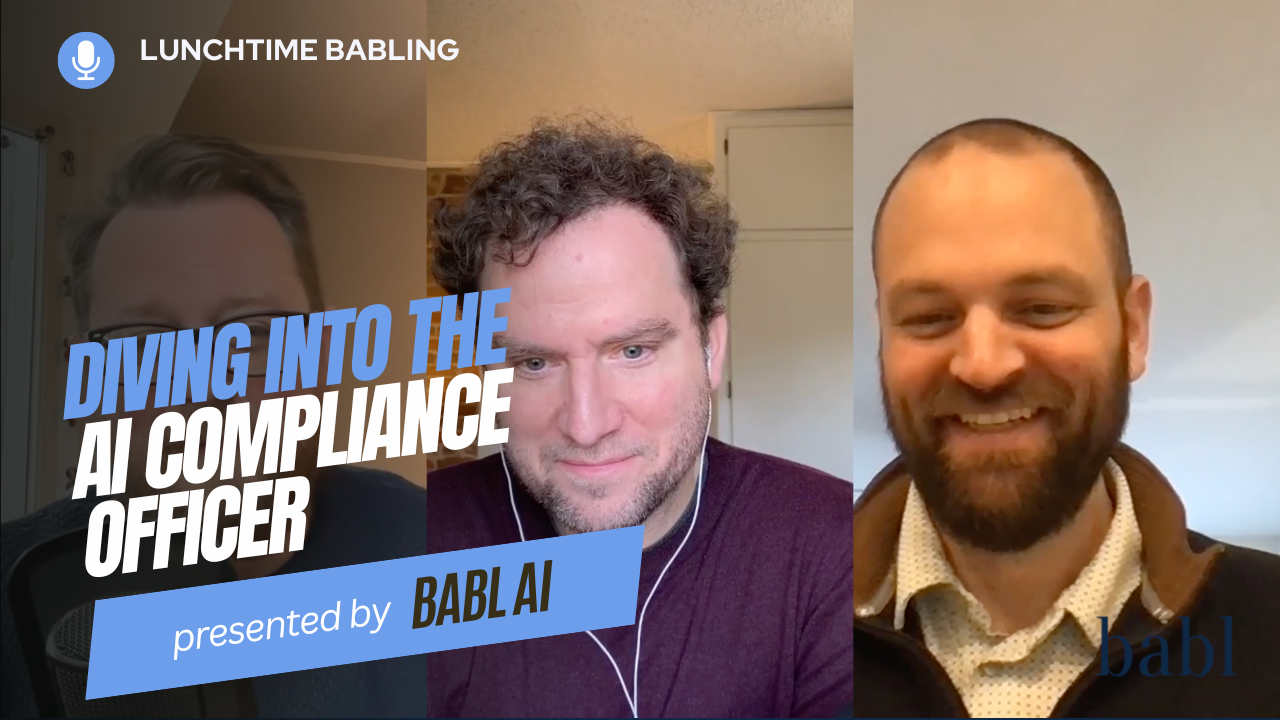

AI governance has moved from an abstract concept to an operational necessity—and many organizations are discovering it the hard way. In the latest episode of Lunchtime BABLing, BABL AI CEO Dr. Shea Brown is joined by COO Jeffery Recker and Chief Sales Officer Bryan Ilg to demystify one of the most misunderstood emerging roles in modern business: the Chief AI Compliance Officer. To leaders overwhelmed by AI regulations, and to employees suddenly handed responsibility for “AI compliance” alongside their day job, this conversation cuts through the confusion with practical guidance rooted in BABL AI’s audit work and compliance program.
A New Leadership Gap
Most organizations are farther along in their AI adoption than they realize—and simultaneously far less prepared to manage the risks. From workplace tools with embedded models to departments experimenting with generative agents on their own, AI has seeped into daily operations long before governance structures have caught up. Jeffery notes that this unintentional adoption is what leaves leaders uneasy. Lawsuits around data use, new state and federal requirements, and the sweeping obligations in the EU AI Act have created a moment where everyone senses risk but no one is quite sure where to begin. That anxiety is not theoretical; it comes from real exposure. Shea’s experience with clients mirrors the trend: general counsel teams are swamped, product teams are unsure how rules apply, and executives need a clear way to turn regulatory complexity into actionable steps.
From Zero Clarity to a PoC in Two Months
One of the most striking parts of the episode is the speed at which organizations can regain control once they follow a structured approach. Shea shares how companies often go from having no inventory, no policies, and no governance structure to building an AI proof of concept in just two months. The turning point comes from establishing a comprehensive system inventory—mapping every AI, automated decision system, embedded feature, and shadow tool already in use. Once the landscape is visible, teams can triage: what’s high risk, what’s medium, and what’s operationally low. Bryan explains that most leaders come in expecting a massive overhaul. Instead, they leave realizing that the real work is building an internal rubric for evaluating risks consistently over time. With that structure, everyone—from legal to engineering to operations—can finally speak the same language.
Why Leaders Are Worried
The conversation takes an unflinching look at why executives feel backed into a corner. Regulations like the EU AI Act introduce mandatory risk management, technical documentation, and ongoing monitoring—requirements many companies don’t currently meet. The European Parliament’s study on digital regulatory friction, discussed in the episode, makes clear that even organizations with strong compliance teams feel overwhelmed. And it isn’t just Europe. Overlapping state laws, upcoming federal rules, and pressure from customers and investors mean risk has become multi-directional. Reputational harm is another core fear. One AI failure—whether a biased model, a bad recommendation, or a security lapse—can erase years of trust. Bryan puts it plainly: when an AI system fails downstream, the collapse isn’t slow. It’s immediate, public, and costly.
Hidden Risks: Data Poisoning, Drift, and Shadow AI
The episode goes deeper into actual technical risks than many discussions do. Shea breaks down data poisoning in clear terms, describing how subtle manipulations during training or fine-tuning can degrade a model without obvious signs. He also highlights model drift and data drift as ongoing realities—not one-time checks. These issues can lead organizations into “firefighting mode,” where teams scramble to fix failures while customers lose confidence. Shadow AI remains one of the biggest governance gaps. Employees circumventing internal rules by using personal or unapproved tools can unknowingly expose sensitive data or introduce unvetted systems. Without monitoring and clear policies, organizations often discover shadow use only after something has gone wrong.
The Rise of the Chief AI Compliance Officer
Throughout the episode, a central theme emerges: organizations need someone who owns the AI compliance lifecycle. Not as a symbolic title or a side responsibility but as a structured role equipped to manage risk, governance, documentation, and cross-functional coordination. Shea outlines BABL AI’s AI Compliance Officer Program, which gives organizations the foundation, support, and monitoring tools required to operate safely. The role isn’t about slowing innovation. As the team emphasizes, governance becomes an enabler when it gives product teams confidence, protects brand integrity, and keeps executives out of crisis-mode decision making.
Governance as a Catalyst for Innovation
The episode ends with a reframing that feels particularly important right now. Governance, risk, and compliance aren’t the brakes—they’re the steering wheel. Companies that treat AI governance as a necessary burden remain reactive and cautious. Companies that embrace governance as infrastructure gain the ability to innovate without chaos. Instead of fearing new AI tools or regulatory scrutiny, they build systems designed for change. A strong compliance function creates clarity, reduces uncertainty, and lets organizations move faster because they understand where the risks are and how to manage them.
Why This Episode Matters
For anyone working in or around AI—whether a lawyer, operations lead, engineer, or manager—this conversation feels like a wake-up call. AI is already embedded in your organization, whether you’re ready for it or not. The question isn’t whether you need AI compliance support. It’s how long you can wait before gaps in oversight become business risks. This episode offers something many leaders desperately need: a roadmap. One that begins not with buzzwords but with visibility, structure, and clear ownership. And for the people suddenly tasked with “figuring out AI,” it provides reassurance that the path forward is both practical and achievable.
Where to Find Episodes
Lunchtime BABLing can be found on YouTube, Simplecast, and all major podcast streaming platforms.
Need Help?
Looking to explore a career in AI governance beyond the headlines? Visit BABL AI’s website for more resources on AI governance, risk, algorithmic audits, and compliance.